
A consulting project under the GIZ regional program on integrated land use in Central Asia.
Objective
The Forest Service under the Ministry of Emergency Situations of the Kyrgyz Republic determines forest stock with a program created more than 20 years ago in Borland Delphi 7 with a Paradox 7 file database. In effect, it is a set of separate applications: entering stand cards for forest enterprises, entering data for specially protected natural areas, field inventory, calculation, stand description, reporting forms and building a coordinate grid. They exchange data through files. Neither documentation nor the program's developers remained. The task was to reconstruct the calculation methodology embedded in the code and prepare a document package for building a modern information system without losing the historical data series.
Sources
The methodology was nowhere described in full, so we worked with three groups of sources.
The system itself
- source code of the calculation and validation modules (Mainform.pas, FM_U.pas, R_U.pas);
- a database backup: 313 Paradox tables that reduce to about 30 entities. Table fields are anonymized, their meaning is given by the labels of the screen forms, and encodings differ from table to table;
- five field inventory forms.
Forest management methodology
- Guidelines for creating and processing the database, including the appendix "Calculation of stock per hectare";
- Guidelines for forest inventory at the forest enterprise level;
- Guidelines for stand assessment and planning of forestry activities;
- Instruction on stand assessment and activity planning in specially protected natural areas of the Kyrgyz Republic;
- Handbook on forest mensuration of Kyrgyzstan (Gan P.A., Cheshev L.S., 1991) — shrub stock standards;
- All-Union standards for forest mensuration (1989) — reference volume standards;
- the sample-based statistical inventory methodology on which the current system is built.
Legal framework
- Forest Code of the Kyrgyz Republic;
- laws of the Kyrgyz Republic "On electronic governance" and "On the right of access to information";
- Government Resolution No. 744 on state information systems;
- Government Resolution No. 762 on information protection;
- GOST 34.602 on terms of reference.
Reconstructed methodology
The calculation has two stages.
Stage 1: sample plot
- For each tree, the height class is determined: the reference "height vs. logarithm of diameter" curve from which the actual height deviates least is chosen.
- Stem volume is taken from height-class volume tables, a quadratic function of diameter. For secondary fruit species, Denzin's formula with a height correction is used.
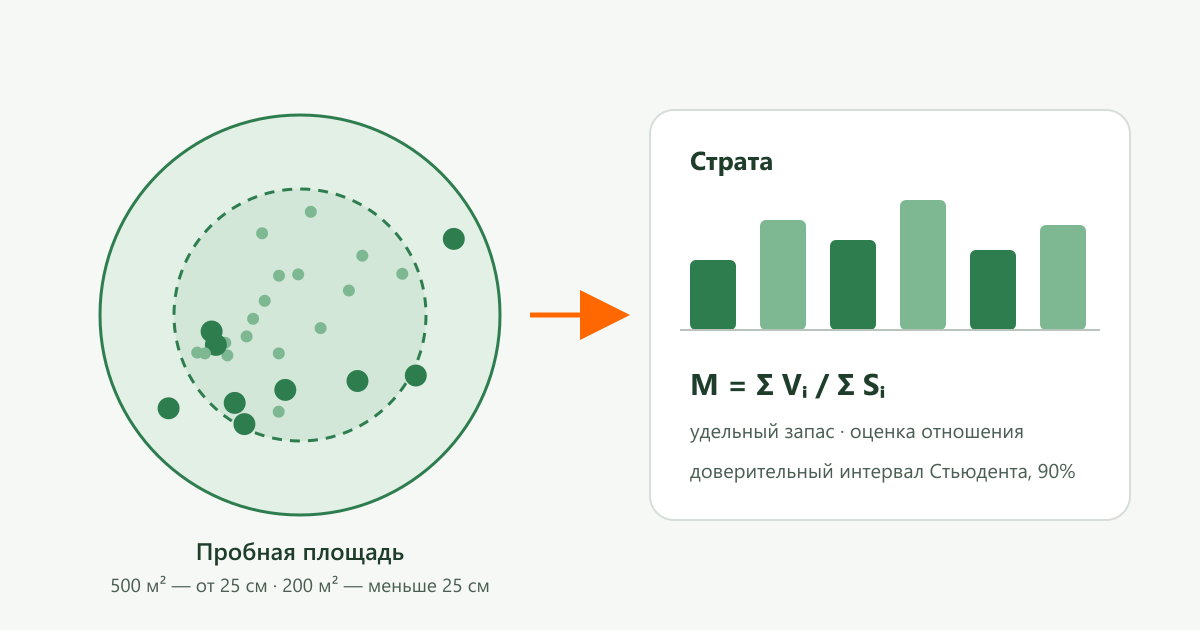
- Trees are counted in two concentric circles: 500 m² for diameters from 25 cm and 200 m² for smaller ones. The per-hectare expansion factor takes into account the actual circle area if the plot crosses a stand boundary.
- Current increment is determined from cores: the tree's diameter a year earlier is modeled and the difference in volumes is calculated.
Stage 2: stratum
- The stock per hectare of a stratum is calculated with a ratio estimator: the sum of plot stocks divided by the sum of their areas.
- Precision is estimated through a variance that accounts for the covariance of stock and area. The confidence interval is built using Student's t-distribution at 90% probability.
- The stock of a stand equals the stock per hectare of its stratum multiplied by the stand area.
- Shrub strata are calculated separately, using the reference handbook with a crown closure correction.
- Regeneration indicators are determined from the frequency of occurrence of species.
Verification
The reconstructed algorithm was run on real data from two forest enterprises:
- height classes matched the current system on all 73,296 records;
- the volume function was reproduced with a root-mean-square error of about 10⁻¹⁶;
- the final stratum statistics matched within machine precision;
- shrub and undergrowth calculations were also confirmed.
Three methodological forks found in the code were referred to Forest Service specialists for a decision and fixed in the algorithm description: Denzin's correction, two-step age averaging and the number of plots per stratum.
Results
- Draft Terms of Reference for the new system under GOST 34.602 and Government Resolution No. 744. It includes a single stand model for forest enterprises and protected areas, support for the SK-42, Kyr_06, UTM and WGS-84 coordinate systems, and extension of the calculations to biomass and carbon under the IPCC methodology.
- An algorithm description with a reference implementation, a catalog of tables and fields, and a register of 270 data validation rules.
- Interactive interface prototypes, including a biodiversity block with selection of Red Book species.
- A development budget and tender documents for the first implementation stage.
The Forest Service now has its methodology in an explicit, verified and documented form. Any contractor can now build the new system, and the results will be comparable with the long-term inventory archive.


